.png)
Change That Lasts: Holly Health Wellbeing Improvements Hold Strong at 12 months
Do improvements in mental wellbeing last? It's the question every health programme should be able to answer, and one that short-term results never can. We looked at wellbeing scores from Holly Health users who joined with lower wellbeing than most, at 8 weeks, 6 months and 12 months after sign-up. Anxiety scores were down by a quarter, happiness up 40%, and the improvements at a year were as strong as those at 8 weeks.
At a glance, 12 months after joining Holly Health:
- 26% reduction in anxiety
- 40% increase in happiness
- 34% increase in sense of purpose
- 33% increase in life satisfaction
- 33% average improvement across all four ONS4 wellbeing measures (29% at 8 weeks, 32% at 6 months)
The Problem With Quick Fixes
Most of us know the pattern. A burst of motivation, a new routine, then life gets in the way and old habits creep back.
Health interventions face the same challenge. Early results are easy to celebrate, but lasting change is what really matters: to the people using a service, and to the organisations investing in it. An improvement that holds for a year is worth far more than one that fades once the support stops.
Who We Looked At
We focused on users who joined Holly Health with lower wellbeing: a score of 0 to 5 out of 10 for happiness, sense of purpose or life satisfaction, or 5 to 10 for anxiety. In other words, people who were probably finding life harder than most when they started.
Users are asked the ONS4 questions, the same four questions the Office for National Statistics uses to measure the nation's wellbeing, when they join and again at 8 weeks, 6 months and 12 months. Between 851 and 1,381 users answered each question at 8 weeks, and between 328 and 549 at 6 and 12 months.
At sign-up, their average anxiety score was around 7 out of 10, nearly double the national average of 3.9. Their happiness, life satisfaction and sense of purpose all averaged below 4 out of 10, roughly half the national averages of 7.0 to 7.3 (ONS, January 2025). For context, only around 1 in 8 adults in Great Britain report low happiness (ONS, February 2026).
What We Found: Improvements That Last
Users reported feeling better within 8 weeks, across every measure. Scores at 6 months were higher again, and at 12 months they were holding at or near their best.
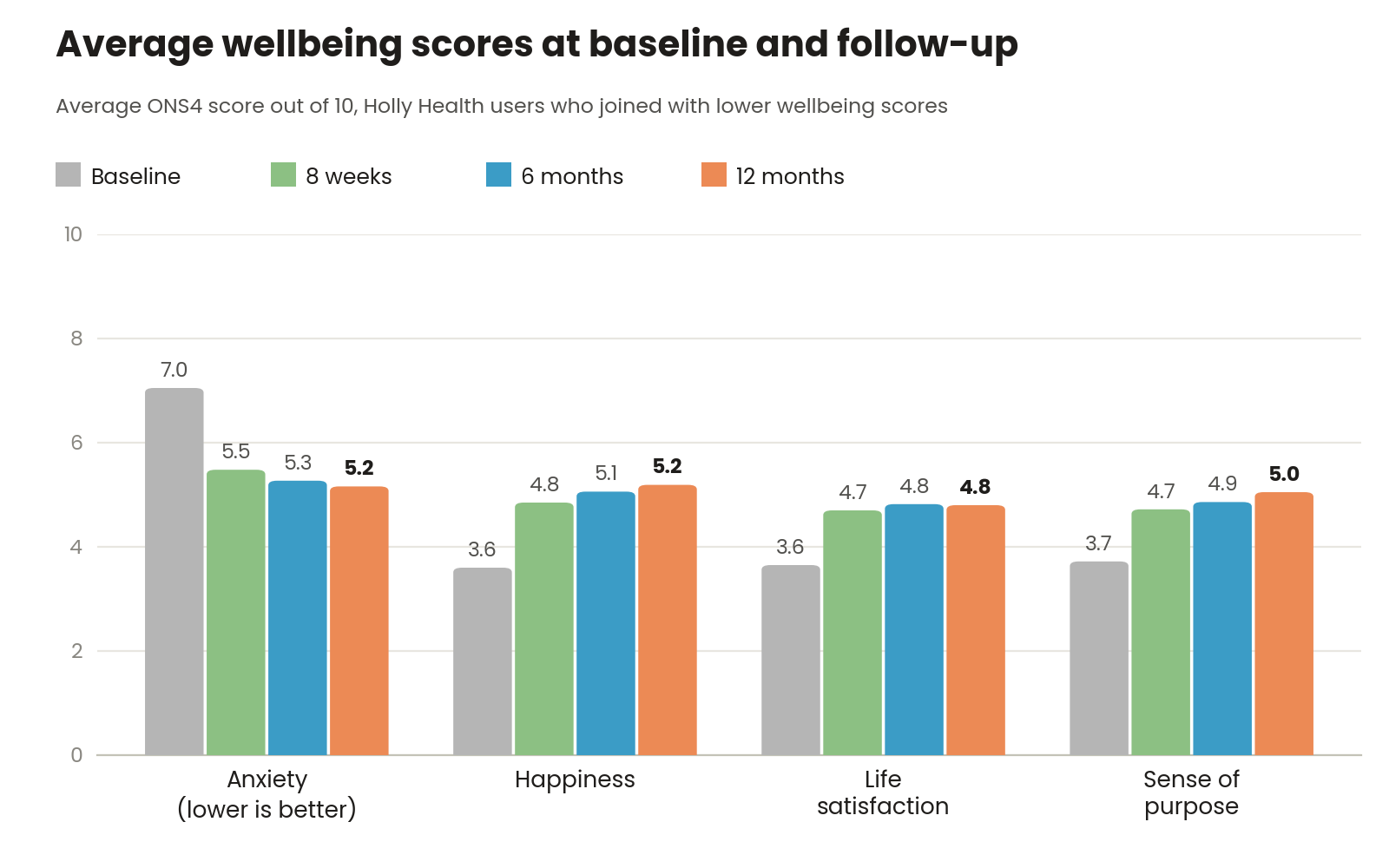
Anxiety: down by a quarter, and staying down. Average anxiety fell from around 7 out of 10 to 5.5 within 8 weeks (down 22%), to 5.3 at 6 months (down 26%), and sat at 5.2 at 12 months (down 26%).
Happiness: up 40%. Average happiness climbed from around 3.6 to 4.9 in the first 8 weeks (up 37%), to 5.1 at 6 months (up 39%) and 5.2 at 12 months (up 40%).
Purpose and life satisfaction: up by a third. Both improved by 28% in the first 8 weeks. By 6 months, life satisfaction was up 34% and sense of purpose up 30%, and at 12 months both were up by around a third.
Most users felt the benefit. Around 6 in 10 users improved on each measure at 8 weeks, 60% to 63% at 6 months, and up to 65% at 12 months.
What helps Change Stick
Most people give up on a health change the moment they feel they've failed. Holly Health is designed to remove those failure points, with encouragement and structure for small, achievable changes.
Personal, doable steps
Each person starts with two habits recommended just for them, based on their goals, current lifestyle, mental wellbeing and any health conditions. Every step is small enough to succeed at, so confidence and progress build day by day.
A compassionate coach
Holly's tone of voice is built with common health challenges in mind. When a habit is missed, the messaging treats it as a normal part of change and a chance to learn, never a lack of willpower.
"I like the way that it's tiny steps, really tiny steps that are doable and achievable, so you never really feel like you've failed."
Habits that become second nature
Small actions, repeated in the right moments, turn into routines people no longer have to think about. After 8 weeks, 62% of users in primary care have built at least one new automatic habit.
Built on science
Holly Health draws on behavioural activation, CBT, Acceptance and Commitment Therapy and mindfulness, with 46 behaviour change techniques woven into every part of the app.
"I'm managing anxiety better, and severe episodes of anxiety are more rare. I'm getting out of the habit of negative automatic thinking."
Why This Matters For Health And Care Partners
Demand for mental wellbeing support keeps growing, and it rarely comes alone: half of the users in our survey of people with long-term conditions reported depression or anxiety. These results show that people who start out struggling report real improvements through one digital service, and that those improvements are as strong at a year as they are at 8 weeks.
- Outcomes that last. Improvements measured at 8 weeks were matched or exceeded at 6 and 12 months.
- Personalised by AI. Just-In-Time Adaptive Interventions (JITAI) learns from each person's interactions and check-ins, such as mood, to choose the right motivational message and the right moment to send it.
- Built for whole populations. Holly Health is designed to reach everyone who needs it, from as little as £0.10 per person per year.
- Trusted by the NHS. Holly Health has been deployed by more than 250 NHS and healthcare partners, and won the Data Driven Innovation & Collaboration Award 2026 with NHS Ayrshire & Arran.
- Clinically recognised. In NHS settings, Holly Health Habit Coach is a registered Class 1 medical device and Digital Mental Health Technology.
Interested in finding more? Email the team at hello@hollyhealth.io


.png)


