.png)
Tackling Multimorbidity with AI: That's a Wrap
We're excited to share the outcomes of an 18-month journey that has pushed the boundaries of digital health support for people living with multiple long-term conditions.
The Challenge
Around one in three UK adults lives with multimorbidity (two or more long-term health conditions), accounting for approximately 70% of total NHS health and social care expenditure. This contributes to an estimated £72 billion spent annually on preventable conditions. The complexity deepens when you consider that 34% of adults with multimorbidity experience both physical and mental health conditions, significantly impacting their ability to self-manage their health.
Supported self-management can slow or even reverse disease progression and reduce demand on health services. Yet there's a critical shortfall of this support in the NHS, creating challenges in access, effectiveness, and scalability.
Why Existing Digital Solutions Fall Short
Most digital health tools rely on relatively fixed characteristics to personalise support. Initial survey data helps us understand users, but it doesn't capture the dynamic nature of multimorbidity such as fluctuating mental health, varying pain levels, and the complex interactions between multiple conditions over time. The personalisation required demands something more adaptive.
Our Approach: Digital Compassion Meets Machine Learning
In partnership with Loughborough University and Modality Partnership, we embarked on an Innovate UK-funded project to develop a highly adaptive, patient-centric multimorbidity support system powered by Just-In-Time Adaptive Interventions (JITAI).
JITAI provides timely, personalised coaching based on each person's unique health patterns and behaviours. Our system operates on a continuous daily cycle using Reinforcement Learning, creating a feedback loop that learns from user behaviour to improve support and plan the next day's coaching messages. Proprietary ML models determine optimal timing (considering mood patterns, day of the week, habit completion) and the most appropriate intervention type.
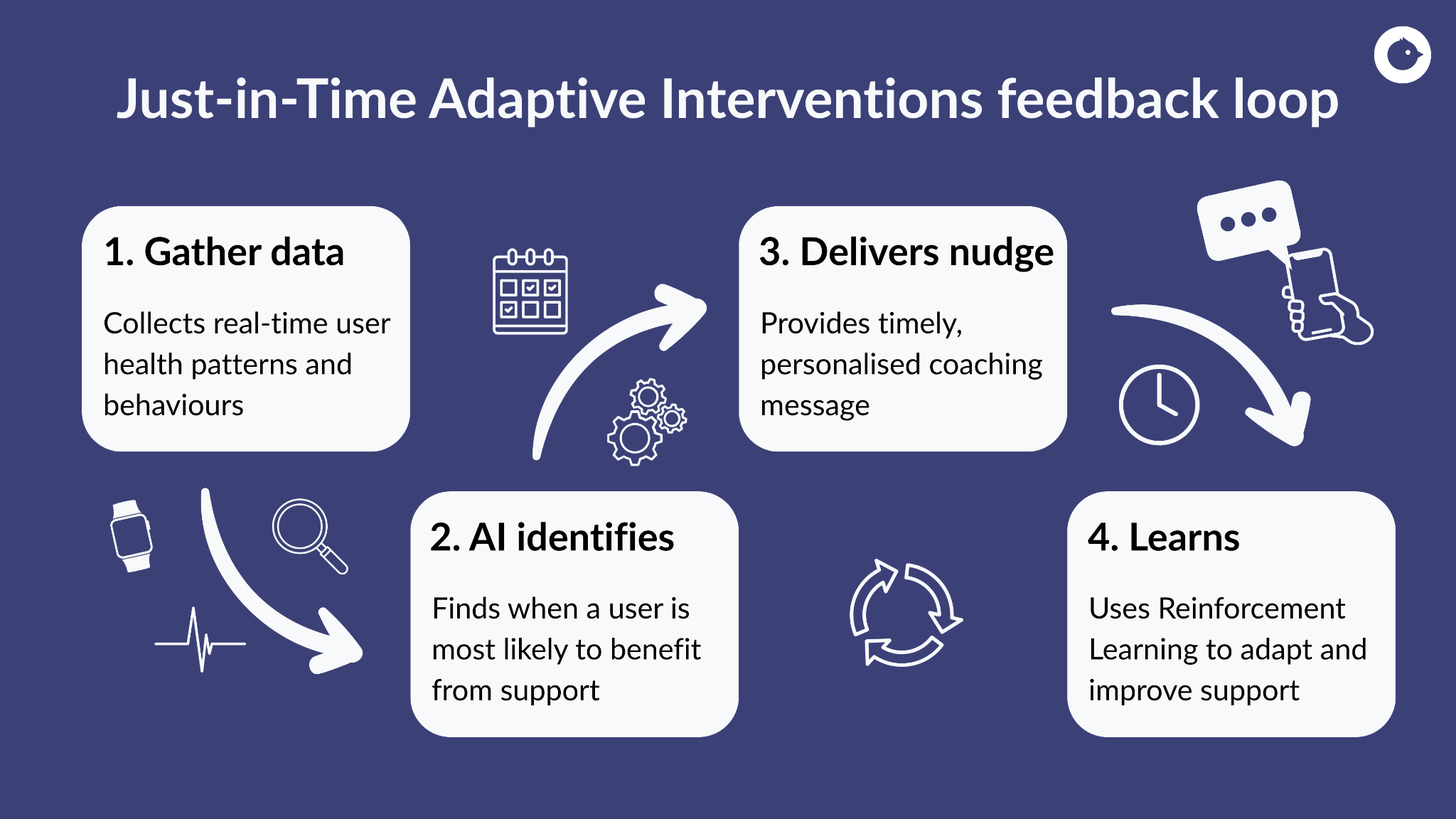
But technology without compassion can't solve the chronic conditions crisis. In a landscape dominated by rigid metrics and guilt-inducing data tracking, Holly Health's uniqueness lies in integrating digital compassion. Sustainable habit change requires an approach that considers mental wellbeing alongside habits, user goals, and current mindset.
Our JITAI nudges are designed to be gentle reminders and suggestions rather than alerts about non-compliance. These help users reduce self-doubt, increase confidence, and prioritise their health through small, achievable changes. By combining machine learning with a supportive, compassionate tone, we address psychological barriers to change that many digital health interventions overlook.
The Results
We analysed results from over 180 users over three months, and the findings were encouraging: embedding JITAI within the Holly Health app significantly improved both engagement and habit completion, both precursors to long-term health improvements.
These outcomes demonstrate the potential for large-scale, digital delivery of personalised self-management support, addressing critical NHS capacity and cost challenges while empowering patients to take greater control of their health.
As Dr James Sanders, academic lead at Loughborough University, noted: "Our collaboration demonstrates the potential of personalised, data-driven support to help people manage multiple long term conditions. By integrating behaviour change research with adaptive machine learning, we can provide the right support at the right time, empowering people to take meaningful action towards better health."
We're working on publishing our detailed results in 2026.
Looking Ahead
Our aim is to become the go-to multimorbidity digital self-management tool at a price point that supports access and scalability. In an NHS where primary care is overburdened, digital interventions that nudge autonomously and with empathy represent a viable way to drive significant behaviour change across populations without increasing clinician workload.
To everyone who participated - our users, clinical partners, and research collaborators - thank you. Your insights have been invaluable in developing a solution that has the potential to transform how we support people living with complex health needs.

.png)


